Journal
Full-Grain vs Top-Grain vs Genuine Leather
Four words do most of the lying in the leather trade. Here is what each grade actually is, why "genuine leather" is close to the bottom, and how to tell them apart with your hands.
A hide is layered, and the grades are just slices of it
Every piece of leather starts as one hide, and a hide is not uniform. The outermost layer — the part that faced the world, where the fibres are tightest and most tangled — is the grain. Beneath it the fibres loosen and run more horizontally, and the deeper you go the weaker and spongier the material becomes. Tanneries split a hide into layers, and the grade names are simply labels for which slice you ended up with.
That is the whole thing. Once you know a hide is layered, the marketing language stops being confusing and starts being quite easy to read.
Full-grain
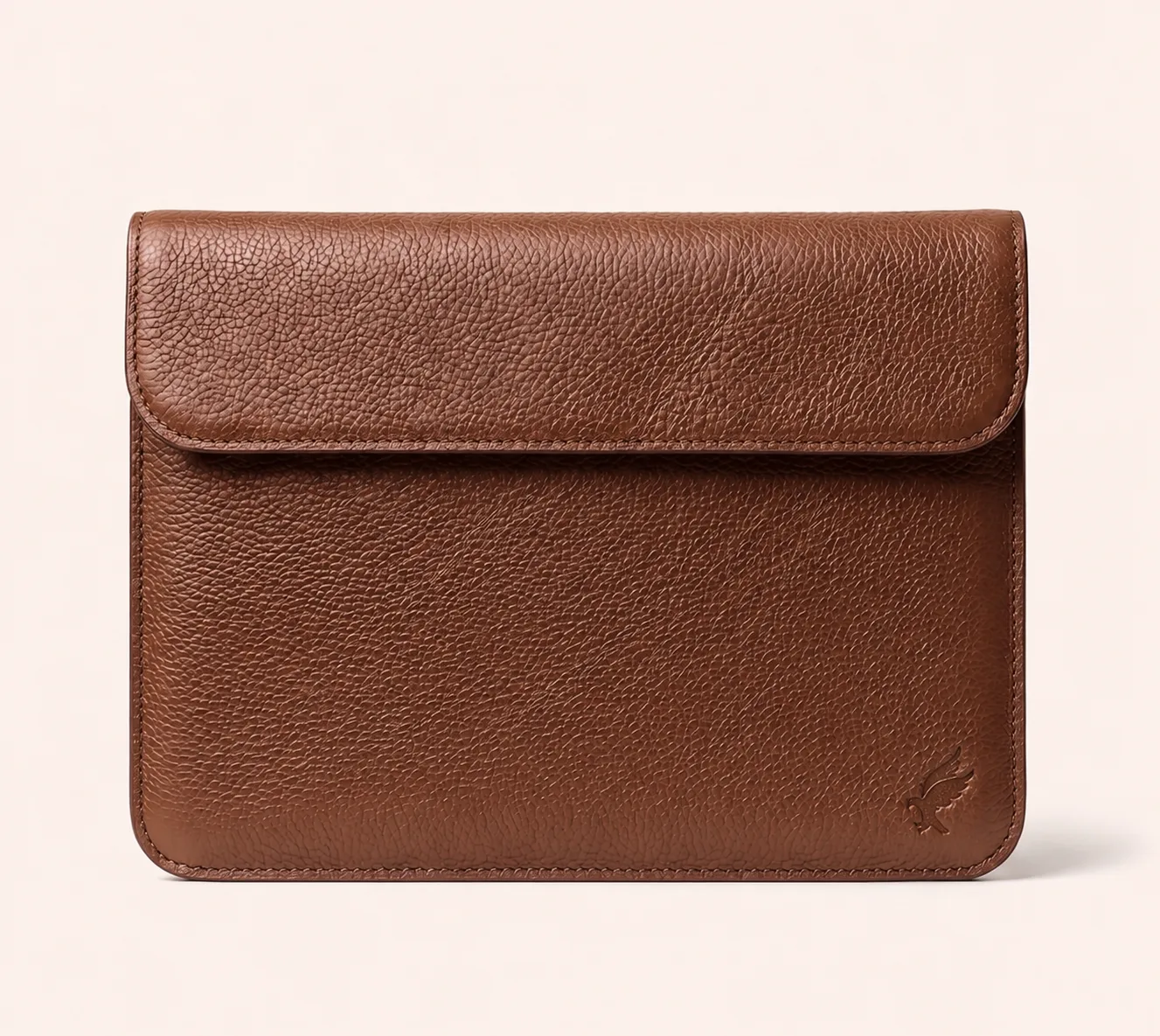
The top layer, complete, with nothing sanded off. Every pore, every wrinkle, every healed scar from the animal's life is still on the surface. That is why no two full-grain pieces are identical, and why full-grain leather is the only grade that develops a real patina — the darkening and softening that comes from skin oils and air reaching fibre that has not been sealed under a coating.
It is also the strongest, because those tightly packed outer fibres are intact. A full-grain piece starts stiff and gets better. It is the grade we use, and it is the only one worth paying for if you intend to keep the thing.
Top-grain
The same top layer, but sanded to remove blemishes and usually sprayed with a finish to even out the colour. It is still a good material — most mid-to-high-end handbags are top-grain — and it is more uniform and more stain-resistant than full-grain.
What you give up is age. Once the surface is buffed and coated, there is nothing left exposed to develop a patina. A top-grain piece looks its best on day one and slowly declines from there. That is the opposite of what you want in something you carry daily for a decade.
"Genuine leather" — the one to watch
This is the phrase that does the damage. It sounds like a certificate of authenticity. It is in fact a grade name, and it sits near the bottom: genuine leather is made from the lower splits left over after the top grain has been removed. It is real leather in the sense that it came from an animal, and that is the only sense in which it is a promise.
Those lower layers have loose, weak fibre, so the material is usually given an artificial grain — embossed, painted, or coated in polyurethane — to look like the top layer it is not. That coating is the failure point. It does not wear, it peels. After a year of daily use a genuine-leather sleeve looks shabby at the corners and shiny where your hands sit, and there is no reconditioning it, because the surface you would be feeding is plastic.
If a product page says "genuine leather" and nothing more specific, read it as "the cheapest layer we could still legally call leather".
Bonded leather
Leather scraps and dust, ground up, mixed with adhesive and pressed onto a fabric backing — the chipboard of the leather world, typically well under twenty per cent actual leather. It is common in cheap laptop sleeves and bags sold online. It cracks and flakes rather than ages, often within months. No care routine saves it.
Tanning: vegetable or chrome
Grade is one axis; tanning is the other, and the two get conflated constantly. Tanning is what stops a hide from rotting. Chrome tanning uses chromium salts and takes about a day — fast, cheap, and it produces soft, colour-stable leather. Vegetable tanning uses tannins from tree bark and takes weeks.
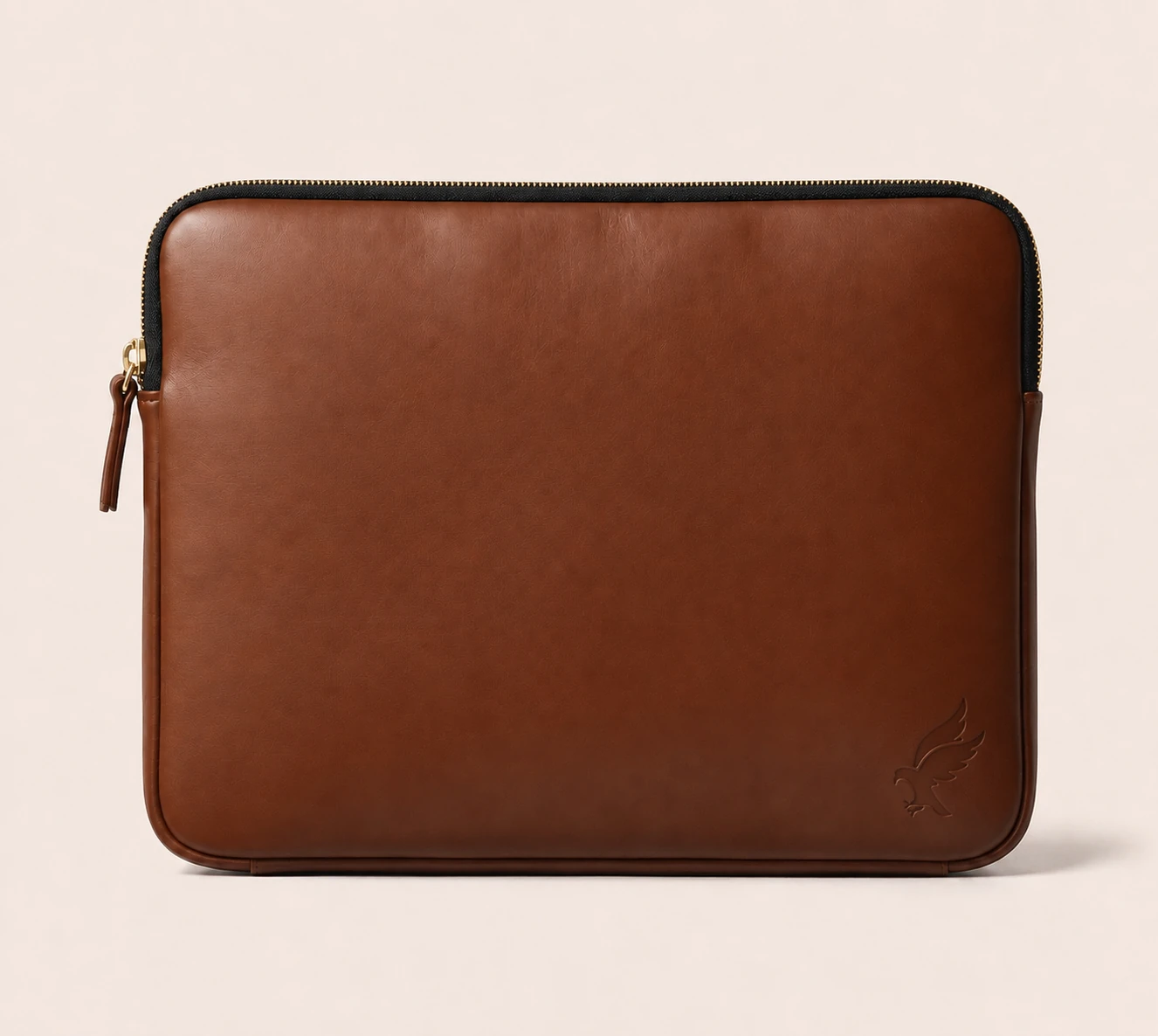
Vegetable-tanned leather starts firmer and is more sensitive to water, but it is the one that darkens richly with use and can be reconditioned for years. Full-grain and vegetable-tanned together is the combination that ages the way people mean when they talk about leather improving. That combination is what our sleeves are cut from.
How to tell, without taking anyone's word for it
- Look at the edge. Full-grain shows a dense, fibrous cross-section in one continuous material. Bonded and coated splits show a distinct surface film sitting on a different-looking backing.
- Look for irregularity. Real grain is uneven — pores vary, there are faint wrinkles and the odd healed mark. A pattern that repeats exactly is embossed.
- Press it with a thumb. Full-grain creases into fine lines around the dent and relaxes back. Coated leather tends to crease sharply and hold the mark.
- Smell it. Vegetable-tanned leather smells woody and faintly sweet. Plastic or chemical smell means a heavy synthetic finish.
- Read the words. "Full-grain" and "top-grain" are specific claims. "Genuine leather", "real leather" and "leatherette" tell you either very little or the opposite of what they seem to.
What this means if you are buying in Pakistan
Pakistan has tanned and worked hide for generations and supplies a great deal of the world's leather goods. The irony is that most laptop sleeves sold here online are labelled "genuine leather" — the low grade — while the good material goes abroad under other people's labels. The price gap between a bonded sleeve and a full-grain one is usually a couple of thousand rupees. The lifespan gap is years.
So the question to ask any seller is not "is this real leather". It is "which layer of the hide is this, and how was it tanned". A seller who knows will answer immediately. A seller who dodges has told you the answer anyway.
What we make
Both LAVEOR pieces are cut from full-grain, vegetable-tanned cowhide and stitched by hand in one workshop in Lahore. They arrive firm, they darken where your hands rest, and they are built to be reconditioned rather than replaced.